Aidan and Joseph O’Brien are becoming more and more dominant – this is the secret weapon powering them
Peter Scargill – Deputy Industry Editor, Racing Post
Published on 25 Jun 2026 Last updated 18:06 25 Jun 2026
Royal Ascot provided the latest showcase for the skills of trainers Aidan and Joseph O’Brien, and the power of their respective stables, with 12 winners between them across the five days.
Superior equine bloodlines, top-class training facilities and brilliant staff and riders are leveraged by the pair alongside their own talents. But their advantage over the field extends deeper – and is being exploited to help steamroll opposition with regularity on major racedays.
The use of data and analytics has become a cornerstone of both operations. Minute details are pored over in addition to what is seen by the eye of the trainer and felt by the hands of riders.
The optimisation of this weapon, allied to the power and wealth already behind them, only promises to extend the lead the O’Briens have over the rest of the field.
Smarter information, smarter results
There are few angles that Coolmore have not explored in a bid to gain an advantage. Data and analytics are the latest of these, with numerous companies engaged to ascertain what they could deliver to the racing and breeding superpower.
When asked about the use of data analytics in Coolmore’s approach, nominations director Mark Byrne said that, while data and AI were always of interest, “in Coolmore it is, and has always been, about the horse”.
As honourable an outlook as that is, it is not the entire ethos. After all, horses trained at Ballydoyle are fitted with data trackers provided by a company founded by Annemarie O’Brien, Aidan’s wife.
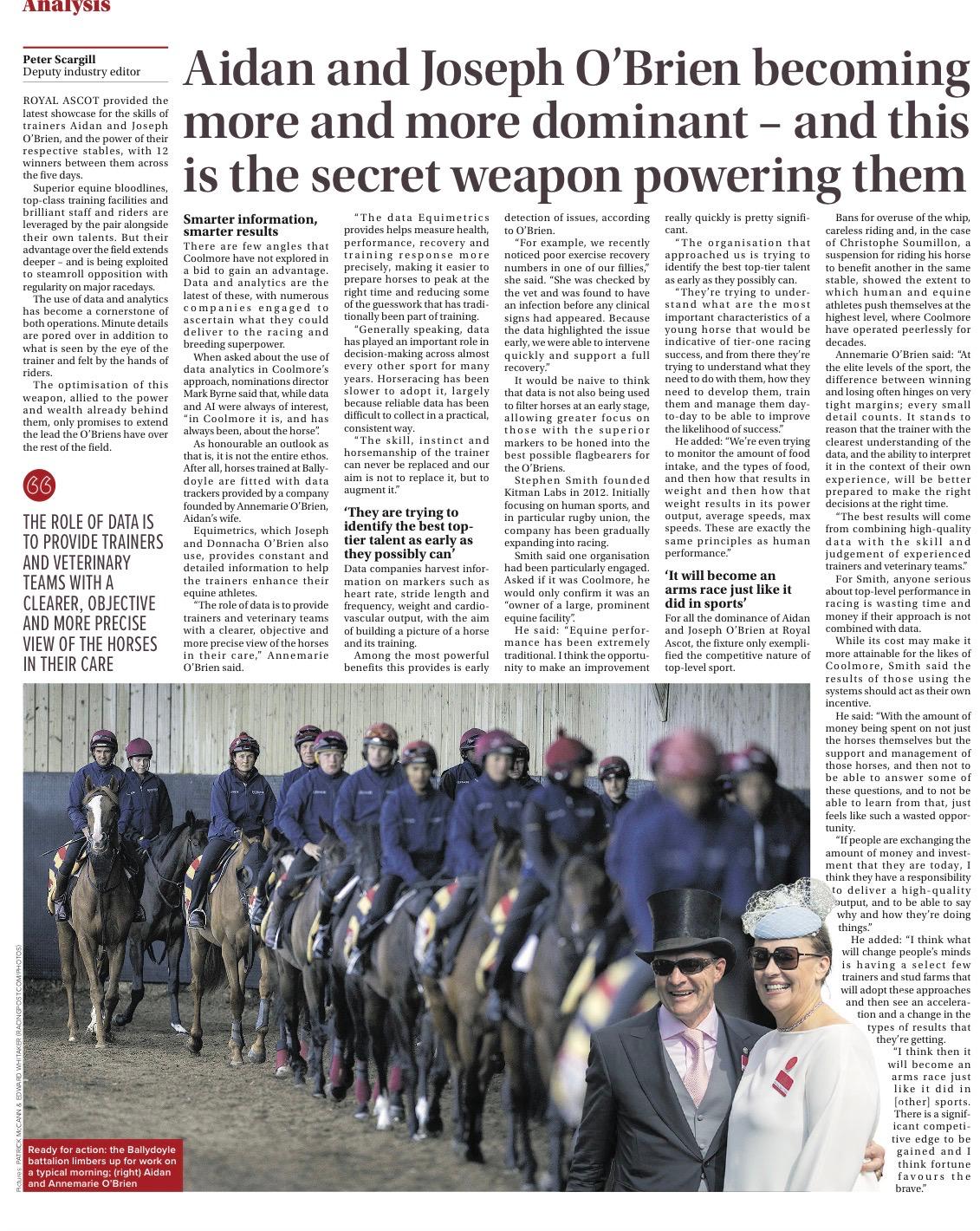
Aidan and Annemarie O’Brien at Royal Ascot
Aidan and Annemarie O’Brien at Royal Ascot last week (Patrick McCann)
Equimetrics, which Joseph and Donnacha O’Brien also use, provides constant and detailed information to help the trainers and their teams enhance their equine athletes.
“The role of data is to provide trainers and veterinary teams with a clearer, objective and more precise view of the horses in their care,” Annemarie O’Brien said.
“The data Equimetrics provides helps measure health, performance, recovery and training response more precisely, making it easier to prepare horses to peak at the right time and reducing some of the guesswork that has traditionally been part of training.
“Generally speaking, data has played an important role in decision-making across almost every other sport for many years. Horseracing has been slower to adopt it, largely because reliable data has been difficult to collect in a practical, consistent way.
“The skill, instinct and horsemanship of the trainer can never be replaced and our aim is not to replace it, but to augment it.”
‘They are trying to identify the best top-tier talent as early as they possibly can’
Data companies harvest information on markers such as heart rate, stride length and frequency, weight and cardiovascular output, with the aim of building a picture of a horse and its training.
Among the most powerful benefits this provides is early detection of issues, according to O’Brien.
“For example, we recently noticed poor exercise recovery numbers in one of our fillies,” she said. “She was checked by the vet and was found to have an infection before any clinical signs had appeared. Because the data highlighted the issue early, we were able to intervene quickly and support a full recovery.”
It would be naive to think that data is not also being used to filter horses at an early stage, allowing greater focus on those with the superior markers to be honed into the best possible flagbearers for the O’Briens.
Stephen Smith founded Kitman Labs in 2012. Initially focusing on human sports, and in particular rugby union, the company has been gradually expanding into racing.
Constitution River working at Ballydoyle on Monday
Sensors are used to gather data from all horses in training at Ballydoyle (Patrick McCann (racingpost.com/photos))
Smith said one organisation had been particularly engaged. Asked if it was Coolmore, he would only confirm it was an “owner of a large, prominent equine facility”.
He said: “Equine performance has been extremely traditional. I think the opportunity to make an improvement really quickly is pretty significant.
“The organisation that approached us is trying to identify the best top-tier talent as early as they possibly can. They’re trying to understand what are the most important characteristics of a young horse that would be indicative of tier-one racing success, and from there they’re trying to understand what they need to do with them, how they need to develop them, train them and manage them day-to-day to be able to improve the likelihood of success.”
He added: “We’re even trying to monitor the amount of food intake, and the types of food, and then how that results in weight and then how that weight results in its power output, average speeds, max speeds. These are exactly the same principles as human performance.”
‘It will become an arms race just like it did in sports’
For all the dominance of Aidan and Joseph O’Brien at Royal Ascot, the fixture only exemplified the competitive nature of top-level sport.
Bans for overuse of the whip, careless riding and, in the case of Christophe Soumillon, a suspension for riding his horse to benefit another in the same stable, showed the extent to which human and equine athletes push themselves at the highest level, where Coolmore have operated peerlessly for decades.
Annemarie O’Brien said: “At the elite levels of the sport, the difference between winning and losing often hinges on very tight margins; every small detail counts. It stands to reason that the trainer with the clearest understanding of the data, and the ability to interpret it in the context of their own experience, will be better prepared to make the right decisions at the right time.
“The best results will come from combining high-quality data with the skill and judgement of experienced trainers and veterinary teams.”
Joseph O’Brien: leading his father at the top of the Royal Ascot pecking order
Joseph O’Brien: five winners at Royal Ascot last week (Patrick McCann)
For Smith, anyone serious about top-level performance in racing is wasting time and money if their approach is not combined with data.
While its cost may make it more attainable for the likes of Coolmore, Smith said the results of those using the systems should act as their own incentive.
He said: “With the amount of money being spent on not just the horses themselves but the support and management of those horses, and then not to be able to answer some of these questions, and to not be able to learn from that, just feels like such a wasted opportunity.
“If people are exchanging the amount of money and investment that they are today, I think they have a responsibility to deliver a high-quality output, and to be able to say why and how they’re doing things.”
He added: “I think what will change people’s minds is having a select few trainers and stud farms that will adopt these approaches and then see an acceleration and a change in the types of results that they’re getting.
“I think then it will become an arms race just like it did in [other] sports. There is a significant competitive edge to be gained and I think fortune favours the brave.”
You can see the Article Here