
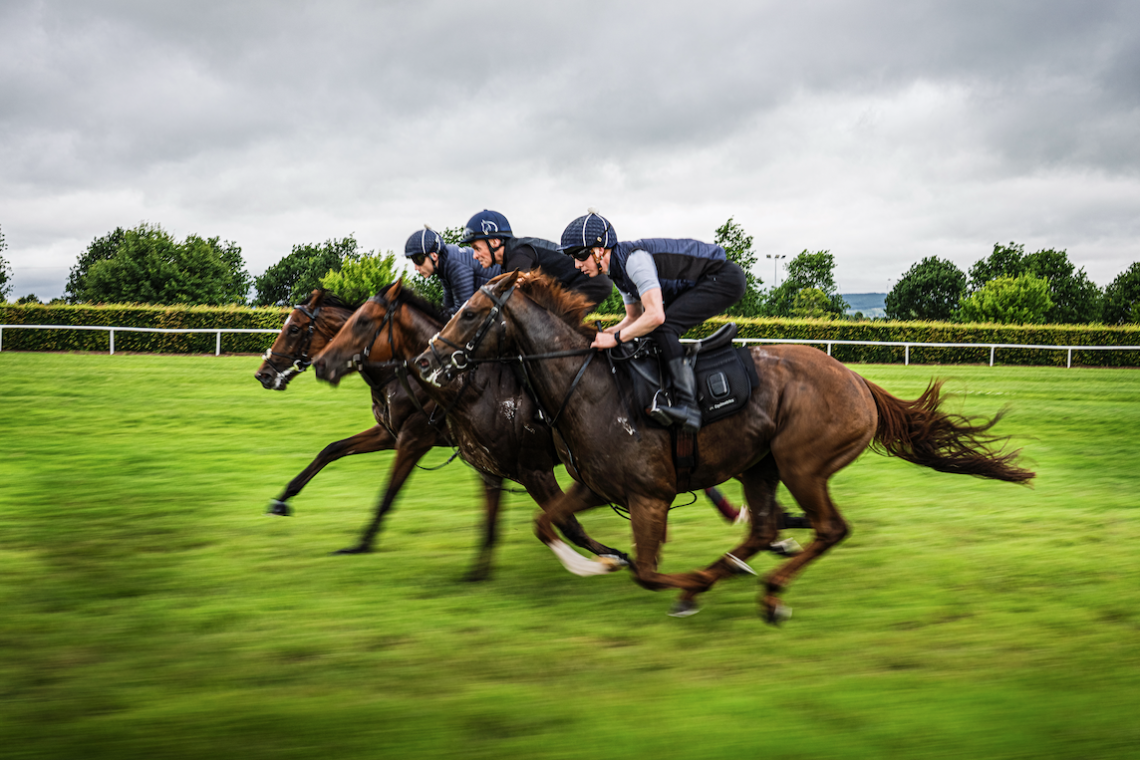
When it comes to equine performance and welfare, Heart Rate Recovery (HRR) is an important early warning indicator.
Correctly reading and interpreting HRR data is one of the best ways to identify possible injury or illness before it becomes symptomatic. This can allow trainers and vets to intervene earlier, reduce recovery time and, in some cases, help prevent more serious outcomes.
The same data can also provide valuable feedback on a horse’s overall fitness, current training programme, and progress against relevant performance targets.
S-PRO provides a comprehensive overview of HRR. It captures heart rate, and by extension HRR, for as long as the sensor and saddle pad are worn by the horse. We calculate and report HRR for a full five minutes after exercise, measured from the point of maximum heart rate.
For each individual horse, this data can be compared across 7, 30 and 90 days at a glance. Custom reports based on any date range, including the lifetime of the horse, can also be created quickly.
The result is a detailed early-warning system that helps protect every horse in the yard while supporting the best possible performance.
————-
Every horse, every day
HRR can be useful in isolation. If something is wrong, it may be visible from a single day’s data. But for a reliable monitoring system, it is important to track data over time. This allows each horse to be compared against its own benchmark data, making even small changes easier to spot.
That is why we recommend using S-PRO on every horse, every day.
Occasional use will still provide valuable insight. But to identify emerging issues, it’s best to track each horse consistently and build a reliable data history over time.
To support this, S-PRO is designed to fit into the routine of a busy stable yard. Simply tack up the horse using our smart saddle pad – scan the microchip and pop the sensor into the holster. There are no wires and no fuss. From that point on, data is automatically collected and stored against the relevant horse for review later on the S-PRO App. Each sensor can be used across multiple horses and lots in a single day.
Every time a horse exercises, S-PRO reports HRR at 30 seconds, 60 seconds, 2 minutes and 5 minutes after work ends.
This allows a proper HRR curve to be plotted, giving better insight than a single figure. By capturing these four data points, we maximise the chance of collecting useful data, even if the saddle pad is removed earlier than planned.
What am I looking for?
Simply put, you are looking for any deviation from what is normal for the horse in question and this is why daily monitoring is best.
Context matters. But as a rule, when HRR is not happening at the expected rate, after allowing for the amount and nature of the work on that day, it is time to pause and investigate why.
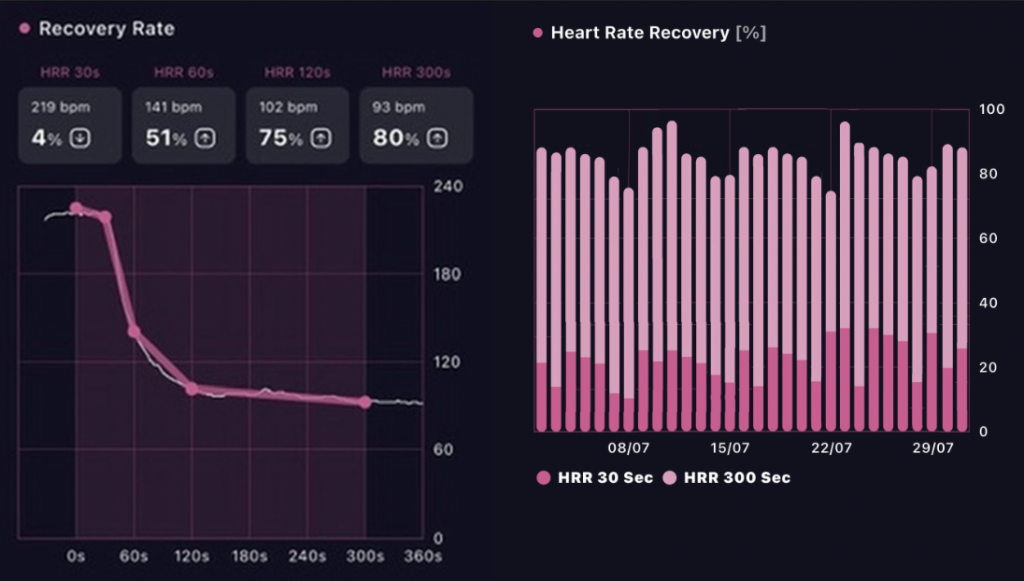
- Regular HRR graph will show rapid recovery to 60 secs followed by a more gradual steady decrease. The percentages will reflect the type of exercise the horse has completed, as well as other contextual factors.
- A sudden drop in HRR could suggest an immediate issue with injury or illness, particularly if it cannot be explained by extra effort or more demanding work that day. This would merit investigation to ensure you are happy with all aspects of the horses wellbeing. S-PRO also collects ECG data automatically and reports stride and cadence data, helping to provide a fuller picture if needed.
- A gradual decline in HRR may indicate that a horse is not coping well with its current training load.
- HRR that appears normal in the initial phase but then fails to continue falling after 60 seconds may indicate discomfort following exercise. This may also be an early warning sign of injury, illness or stress that needs to be investigated.
S-PRO provides both immediate and long-term data, making changes easier to identify and interpret. If an issue arises, the data helps bring it to your attention.
S-PRO derives heart-rate data from an ECG taken during every exercise session. If there is cause for concern, the ECG can be downloaded and sent for veterinary review.
Understanding context
When reviewing HRR, context is key.
S-PRO data is hugely valuable for trainers, veterinarians and others involved in equine welfare and performance, but it does not replace your own understanding of the horse.
Factors such as workload, weather, heat and humidity, ground conditions, travel, location and changes in routine can all affect heart rate recovery.
The S-PRO app allows your team to log many of these variables, making it easier to interpret the data and make more accurate comparisons over time.